
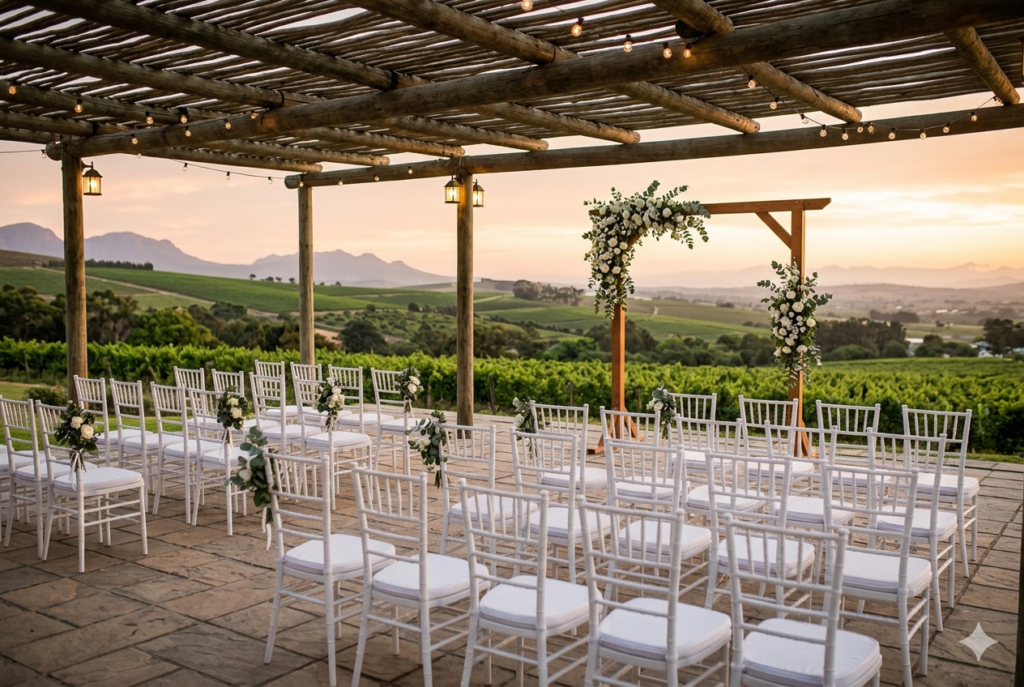
Optimal venue selection on Bottelary Road balances structural capacity with infrastructural resilience. Facilities offering modern material specifications, such as Eikenhof Estate, provide superior operational continuity.
Venues with historic timber-frame construction like Klein Bottelary offer unique environmental integration but require closer inspection of load-bearing limits and power grid dependency. Self-catering venues like Meerdam Farm present a higher degree of logistical variables.
Why Choose a Bottelary Road venue
Choosing a venue on Bottelary Road provides a strategic advantage by blending logistical efficiency with the prestige of the Cape Winelands. Its prime location between Stellenbosch and Brackenfell ensures seamless access to major transport nodes and a high density of professional event services.
Key benefits include:
- Superior Accessibility: Located just 30km from Cape Town International Airport, simplifying travel for domestic and international guests.
- Logistical Efficiency: A high concentration of venues and suppliers in one area reduces “supply chain friction” and simplifies site visits.
- Robust Infrastructure: Established utilities and well-maintained roads reliably support the technical demands of large-scale functions.
- Operational Stability: The region’s predictable climate and abundance of local accommodation minimize the risks of delays or travel complications.
Ultimately, this area offers the perfect balance of rural beauty and urban accessibility, ensuring your wedding remains both spectacular and stress-free.
Top-Rated Wedding Venues on Bottelary Road
A technical evaluation of top-rated venues reveals a spectrum of structural designs and operational capacities. These facilities must be assessed not only for their aesthetic qualities but for their engineering logic, material durability, and ability to withstand the operational stresses of a high-density event, including South Africa’s frequent power interruptions.
Eikenhof Estate: Where Modern Elegance Meets Nature
Eikenhof Estate’s ‘Cap Classique’ reception hall is an example of modern structural design, engineered to support up to 120 guests. The facility is specified with full climate control (air-conditioning) and, critically, is equipped with backup power to ensure operational continuity during load shedding.
This feature is a non-negotiable for any event planner, as it guarantees that lighting, sound systems, and catering equipment remain functional, preventing catastrophic system failure.
- Maximum Capacity: 120 guests (banquet style).
- Power System: Integrated backup power generator.
- Structural Materials: Wooden pergola, natural stone barrier walls, and modern reception hall construction.
- Ancillary Facilities: On-site accommodation, conference centre, and boardroom.
The structure incorporates a covered veranda and an expansive lawn area, which allows for the installation of temporary structures like marquee or stretch tents. This modularity provides operational flexibility. On-site accommodation is available in two separate villas, simplifying logistics for key personnel and the bridal party.
Klein Bottelary: Historic Charm and Vineyard Views
Klein Bottelary presents a different engineering paradigm, with its core structures dating back to the 18th and 19th centuries. The Manor House, built in 1758, and the old Wine Cellar, repurposed as a chapel, utilise historic materials like yellow wood ceilings. While aesthetically unique, these materials have different load-bearing and thermal stability characteristics compared to modern constructions.
The venue accommodates between 60 and 120 guests. A key operational asset is the presence of a generator, which provides resilience against grid failures. The venue also offers on-site accommodation in the form of three bachelor-style cottages. The reliance on historic structures necessitates a thorough assessment of spatial limitations and access points for modern, heavy equipment.
Fort Simon Wine Estate: A Picturesque Fairytale Setting
Fort Simon Wine Estate offers a facility with a maximum capacity of 120 guests for both its chapel and reception venue. The chapel is a converted wine cellar from 1901, which, like Klein Bottelary, brings historic material considerations into play.
The main reception hall, Fort Anna, was constructed in 1969 and provides a more conventional event space. The estate is a working wine farm, which adds a layer of operational complexity with agricultural vehicle movement and production schedules that must be factored into event planning. The venue provides in-house catering services, which can streamline food service logistics but may limit flexibility in supplier selection. The availability of on-site parking is a logistical positive.
Meerdam Farm: Rustic Lapa and Outdoor Celebrations
Meerdam Farm offers a distinct operational model centred on its lapa and lawn areas. The venue provides three large self-catering spaces for hire, a model that transfers a significant portion of logistical responsibility to the client. This includes the provision of all catering, staffing, and potentially, supplementary power systems.
Each hired space is equipped with foundational kitchen and bar areas, but the technical specifications of these utilities must be verified against the requirements of external catering suppliers. This model allows for a high degree of customisation but introduces more variables and potential points of failure if not managed by an experienced technical coordinator. The venue is located on Bottelary Road, ensuring good primary access.
Technical Infrastructure and Logistics: A Framework for High-Performance Event Execution
Successful event execution relies on a precise analysis of structural engineering and mission-critical infrastructure. When evaluating venues like those along Bottelary Road, prioritize a controlled operational environment over aesthetics. While timber-frame farm settings provide a rustic look, they require careful inspection of load limits and insulation. Modern reception halls offer better acoustics and integrated HVAC systems, which are essential for stability during the Highveld’s temperature shifts.
To ensure logistical feasibility and operational continuity, prioritize the following technical variables:
- Load-Bearing Capacity: Verify that electrical, water, and SABS-compliant sanitation systems function under peak load.
- Performance-to-Cost Ratio: Evaluate pricing based on risk mitigation, such as the value of integrated backup power.
- Mission-Critical Power: Ensure the venue has a generator or solar-battery solution with a rapid switchover time to counter load shedding.
- Logistical Connectivity: Factor in the 30 km distance from Cape Town International Airport for guest transit and supply chain access.
- Site Accessibility: Confirm secure parking and unobstructed routes for emergency and supplier vehicles.
Balancing these technical specifications ensures a predictable and high-performing environment for any professional event.
Find Your Perfect Bottelary Road Venue
Choosing the right venue is about balancing your vision for the perfect day with the practical infrastructure that makes it run flawlessly. From the historic charm of Klein Bottelary to the modern, load-shedding-proof setup at Eikenhof Estate, Bottelary Road offers world-class options that ensure your wedding is as seamless as it is beautiful.
Ready to see these stunning Winelands spaces for yourself? Book a private site tour today by clicking the button below to explore the venues, check out the facilities in person, and find the ideal backdrop for your wedding day.
FAQs
What is the average venue hire price for weddings on Bottelary Road?
Venue hire costs are subject to significant operational variables, including season, guest count, and the inclusion of in-house services like catering. A baseline for stately homes or winelands estates often falls into a moderate-to-luxury bracket. For precise performance-to-cost ratios, direct consultation is required to align a venue’s technical specifications with your budgetary framework.
Do Bottelary Road wedding venues have backup power for load shedding?
Several venues, including Eikenhof Estate and Klein Bottelary, have integrated backup power systems such as generators. However, this is not a universal standard. It is imperative to verify the existence and operational capacity of a backup power source for any considered venue to mitigate the high failure-rate associated with grid instability.
What is the guest capacity for venues like Eikenhof Estate and Klein Bottelary?
Both Eikenhof Estate and Klein Bottelary are specified to handle a maximum load of 120 guests. Fort Simon has a similar capacity. This figure typically refers to a seated banquet configuration; different layouts will alter the effective load-bearing and spatial capacity.
How far are Bottelary Road venues from Cape Town International Airport?
The logistical advantage of this region is its proximity to major transport hubs. Bottelary Road is situated approximately 30 kilometres from Cape Town International Airport, a travel time of about 20-30 minutes depending on traffic conditions.